Satellite transport with the care your spacecraft was built with
Years of engineering travel in one container. We organise satellite and spacecraft transport between cleanrooms, test centres and launch sites with routes, equipment and monitoring that respect the limits your team defined.
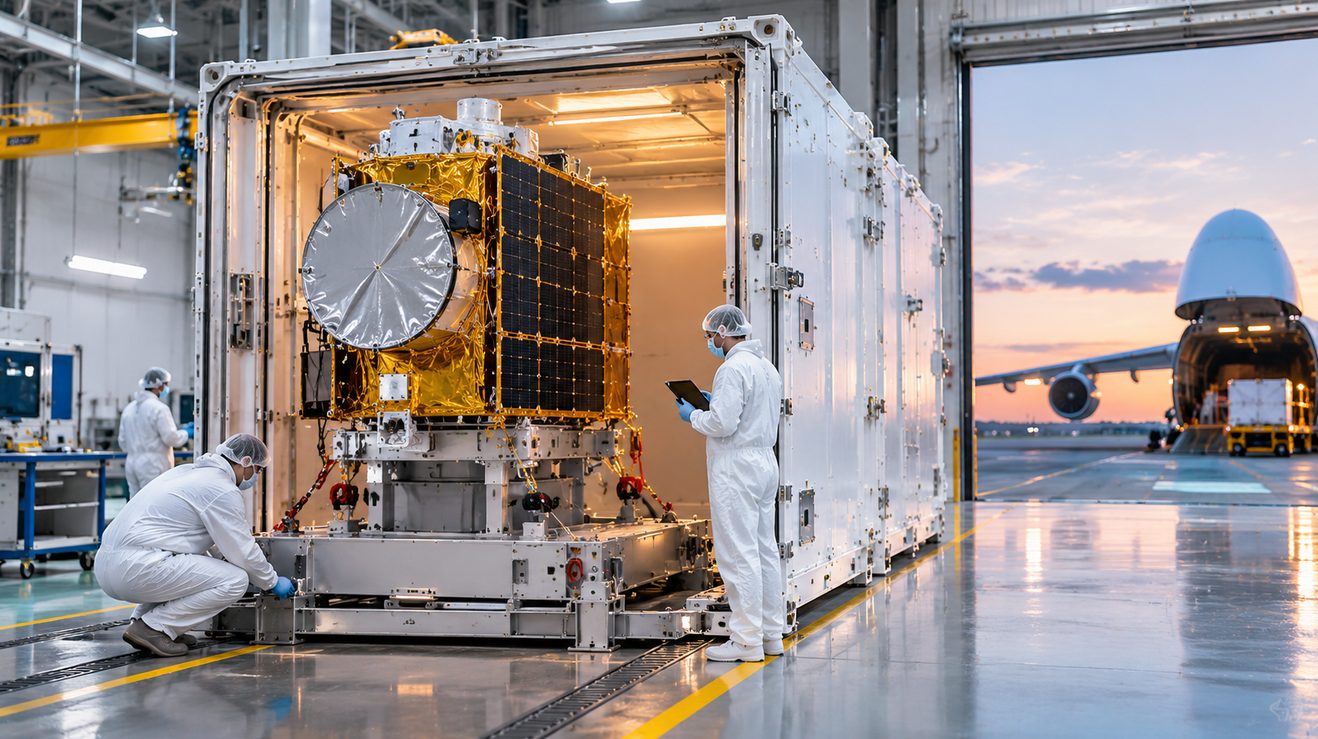
- Typical moves
- Factory to test centre, test centre to launch site, between integration sites
- Modes
- Air charter, scheduled freighters, air-ride road transport
- Environment
- Shock, temperature, humidity and cleanliness limits observed
- Monitoring
- Shock and climate loggers, live tracking where available
- Handling
- Coordination with your container, lifting and cleanroom procedures
- Security
- Restricted information flow and controlled handovers
- Small satellites and CubeSats
- Medium and large spacecraft
- Satellite transport containers
- Payload modules
- Propulsion modules
- Solar arrays
- Antenna reflectors
- Dispensers and adapters
The limits come from your engineers, not from the carrier
Every spacecraft has a qualification envelope: maximum accelerations, temperature and humidity ranges, cleanliness requirements, sometimes a continuous nitrogen purge. Transport must stay inside that envelope from the moment the container leaves the cleanroom until it is opened again.
We start with your transport requirements and translate them into concrete choices: aircraft type and loading method, truck suspension and route, the number of handovers, where the container waits and under which conditions. When a carrier cannot meet a requirement, we tell you before the booking, not after the move.
Charter, freighter or road: chosen per mission
Small satellites often travel in purpose-built cases on scheduled freighters or as road shipments. Larger spacecraft in their transport containers usually need dedicated aircraft or careful road transport with escort. The choice depends on size, weight, sensitivity, distance and the airports and roads that can be used at both ends.
- Air charter Dedicated cargo aircraft when the container size, weight or schedule rules out scheduled services.
- Scheduled freighters For smaller spacecraft and subsystems in suitable cases, with controlled build-up and handling.
- Air-ride road transport Dedicated vehicles with air suspension, temperature control and planned routes without transshipment.
- Surveyed routes Road routes checked in advance for bridges, clearances and surfaces when the load is oversized.
Evidence, not assumptions
After a transport, your team needs to know that the spacecraft stayed within its limits. We coordinate shock and climate loggers with your quality team, make sure they are read out at the right moments and hand over the data together with the delivery documents. If something exceeded a threshold, you know immediately and can decide on inspection before integration continues.
How the process runs
- 01/05Requirements review
We go through your transport requirements, container data, handling procedures and the dates of the move.
- 02/05Route and equipment
Aircraft, vehicles, routes and handling points are selected and checked against the requirements.
- 03/05Readiness check
Loggers, documents, permits, escorts and site access are confirmed before the container leaves the cleanroom.
- 04/05Controlled transport
The move is executed with monitoring and status updates at every handover.
- 05/05Handover and data
Delivery to the receiving facility, logger readout and documentation handed over for your records.
Related services and guides
Satellite & Spacecraft Transport: FAQ
Your question is not here? Write to ops@zl-space.com. A specialist answers, not a ticket system.
How are satellites transported?
Satellites travel in dedicated transport containers or cases that protect them against shock, contamination and climate. Depending on size and destination, they are flown on chartered cargo aircraft or scheduled freighters, or moved by air-ride road vehicles. Shock and climate loggers record the conditions during the whole transport.
Can you transport a satellite under nitrogen purge?
Purged containers need a supply concept for the whole journey, including waiting times at airports and handovers. We plan the purge supply together with your team and the carriers and include it in the transport plan.
Who provides the satellite transport container?
In most cases the spacecraft manufacturer or the programme owns or rents the container. We coordinate its use, the loading equipment and the handling at each location. If a suitable container is not available, we can help you find options.
What happens if a shock threshold is exceeded during transport?
You are informed as soon as the logger data shows it, together with the time and location of the event. Your engineering team decides whether an inspection is needed. Clear documentation of the event also supports any insurance or carrier claims.
Plan your next mission-critical shipment with a dedicated space logistics team
Tell us about the hardware, the route, the customs and export situation and the date it has to be there. Sensitive programme details can follow under NDA.