Ground station logistics, to the ends of the Earth
Ground stations are built where the sky is good, not where the roads are. Antennas, reflectors, radomes, RF chains and server racks have to reach polar regions, islands and deserts, and spare parts have to follow quickly when a station goes down. We plan these deliveries from the factory to the foundation.
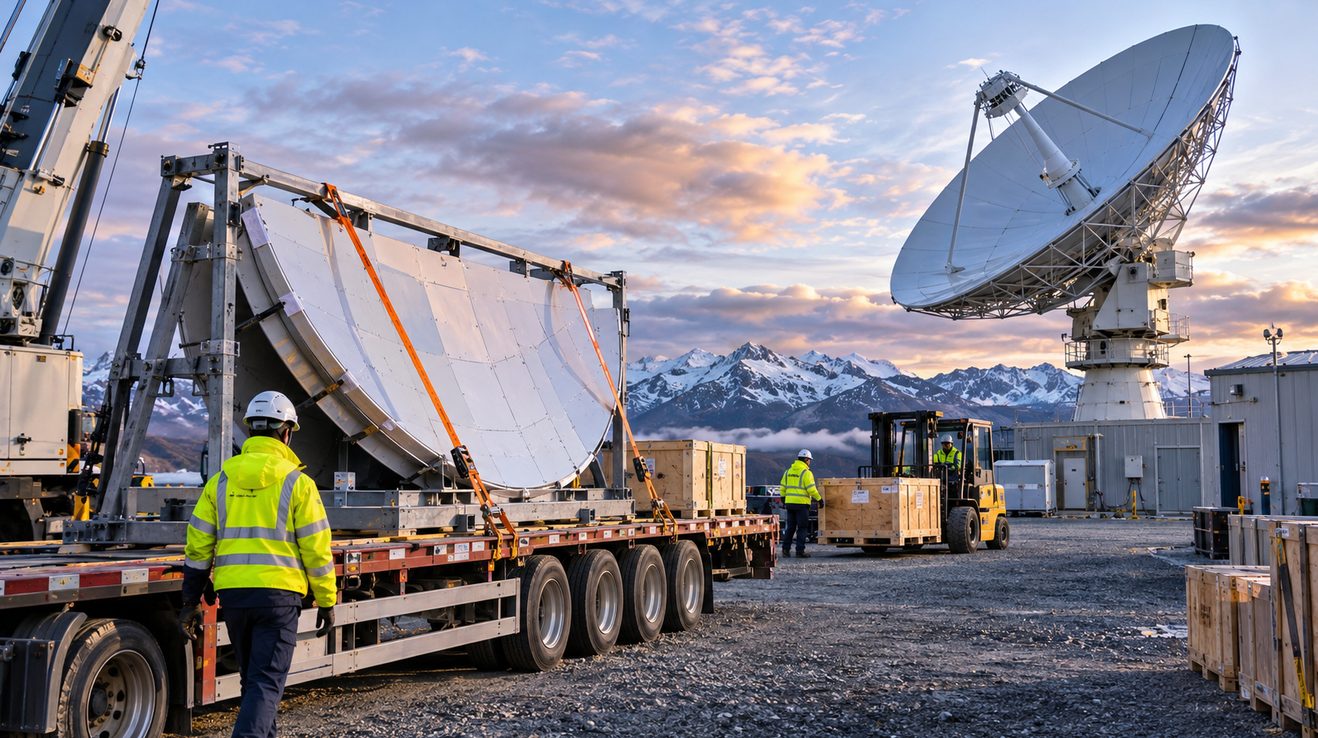
- Typical cargo
- Antennas and reflectors, radomes, pedestals, RF and baseband equipment, IT racks
- Destinations
- Ground stations and teleports worldwide, including remote sites
- Key issues
- Oversized parts, difficult access, customs, seasonal windows, spares
- Customs
- Import, temporary admission for tools, export control for RF and encryption
- Support
- Installation-ready delivery, spare parts and urgent replacements
- For
- Satellite operators, ground segment providers, antenna manufacturers
- Antenna reflectors and panels
- Pedestals and positioners
- Radomes
- Feeds and LNAs
- RF and baseband equipment
- Server and IT racks
- Generators and UPS
- Spare parts
Remote sites, fragile parts, fixed windows
Ground stations are placed for coverage: high latitudes for polar orbits, islands for ocean passes, deserts for clear skies. That makes them some of the hardest places to deliver to. Reflector segments and radomes are large and easily damaged, access may depend on the season, ice or a single weekly ship, and local customs may not be used to RF and IT equipment.
If an installation crew arrives and a crate is missing, the cost is not the freight but the lost window. We plan ground station deliveries around the installation schedule and the realities of the site.
From the factory to the foundation
We coordinate deliveries for new stations, upgrades and operations.
- New stations and upgrades Complete antenna systems, radomes, shelters and IT equipment delivered installation-ready and in the right order.
- Remote and polar sites Route planning with seasonal windows, sea and air legs, last-mile transport and storage on site.
- Customs and export control Import clearance, temporary admission for installation tools and export control checks for RF and encryption equipment.
- Spares and urgent replacements Spare part flows and time-critical deliveries when a station component fails.
- Returns and repairs Defective units shipped back to the manufacturer with the right customs procedure.
Delivered in the order the crew needs it
A ground station is built in a sequence: foundations, pedestal, reflector, feed, RF chain, IT. We align packing lists, crate marking and delivery order with that sequence, so the installation crew can work without searching for parts. Where storage on site is limited, we plan staged deliveries instead of one large shipment.
How the process runs
- 01/05Site review
We look at the location, access routes, seasonal windows, customs and the installation schedule.
- 02/05Shipment plan
Crates, routes, modes and delivery order are aligned with the installation sequence.
- 03/05Customs and permits
Import, temporary admission, export control and oversized load permits are prepared.
- 04/05Delivery
Equipment moves to the site with status updates and condition checks at each handover.
- 05/05Operations support
Spare parts, urgent replacements and repair returns are handled with the same team.
Related services and guides
Ground Station Logistics: FAQ
Your question is not here? Write to ops@zl-space.com. A specialist answers, not a ticket system.
How are ground station antennas shipped?
Reflector segments, pedestals and radomes are usually shipped in custom crates or frames, often as oversized cargo by sea and road, with air freight for urgent or smaller parts. The delivery order is aligned with the installation sequence.
Can you deliver to remote or polar ground stations?
Yes. We plan routes with seasonal windows, limited sea or air connections and last-mile transport, and coordinate storage on site where needed.
Is ground station equipment export controlled?
Some RF, baseband and encryption equipment can be subject to export control. Classification remains with the exporter; we make sure documents and declarations reflect it correctly.
Do you handle spare parts for operating stations?
Yes. We set up spare part flows and organise urgent replacements, including next flight out or on-board courier for critical components.
Plan your next mission-critical shipment with a dedicated space logistics team
Tell us about the hardware, the route, the customs and export situation and the date it has to be there. Sensitive programme details can follow under NDA.